
LASTMA warns against consuming spilled groundnut oil after Ojota tanker crash
The Lagos State Traffic Management Authority (LASTMA) has issued a cautionary notice to residents, commercial traders, and food vendors, advising them against the consumption or distribution of groundnut oil that was discharged from an overturned 33,000-litre tanker located at Ojota Bridge, proceeding toward Old Toll Gate, Lagos, due to apprehensions regarding potential contamination.
The tanker is reported to have capsized in the vicinity of Abiola Garden, resulting in complete obstruction of the roadway and impeding vehicular traffic along the impacted corridor.
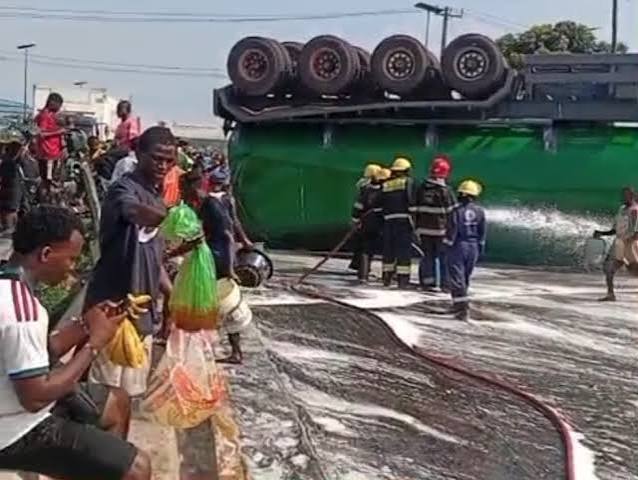
A significant traffic congestion emerged on the Lagos-Ibadan Expressway on Wednesday following the overturning of a tanker transporting 33,000 litres of groundnut oil proximate to Abiola Garden, in the direction of Toll Gate, Lagos.
The incident allegedly transpired at approximately 2pm near Ojota Bridge, with the tanker's contents being released onto the roadway.
In the aftermath of the accident, numerous residents were observed collecting the discharged groundnut oil from the location.
Emergency personnel, comprising representatives from the Lagos State Traffic Management Authority (LASTMA) and the Nigeria Police Force, responded to the scene to regulate traffic flow and coordinate retrieval operations.
The impacted roadway section was secured through cordoning to safeguard public welfare, whilst recovery endeavours proceeded.
Initial investigative reports ascribed the accident to suspected brake malfunction, resulting in the mobilization of emergency personnel to extract the overturned tanker, regulate traffic, and reinstate standard vehicular movement.
LASTMA deployed its rescue and recovery personnel, accompanied by two large-capacity towing vehicles, to extract the overturned tanker and alleviate the consequent traffic obstruction.
Traffic regulation officers were strategically stationed throughout the scene to supervise vehicular flow and execute alternative routing measures to diminish the incident's consequences for road users.
The organization's General Manager, Olalekan Bakare-Oki, communicated apprehension regarding documented instances of individuals gathering spilled groundnut oil from the roadway, sewage systems, and other accessible locations with the intention of consumption or commercial resale.
He cautioned that the petroleum product could have undergone contamination via interaction with roadside debris, atmospheric contaminants, sewage discharge, and other dangerous materials, thereby creating substantial health dangers for uninformed purchasers.
Bakare-Oki appealed to inhabitants, commercial operators, and food service providers to refrain from gathering, ingesting, or disseminating the salvaged petroleum, emphasizing that recovery efforts for dispersed goods must not supersede considerations of community health and welfare.
He advised that ingestion of tainted cooking oil might subject persons to preventable medical conditions, imploring the general population to demonstrate prudence and comply with the guidance provided.
Additional organizations participating in the mitigation comprised the Nigeria Police Force, Federal Road Safety Corps, Nigeria Union of Petroleum and Natural Gas Workers, Lagos State Fire and Rescue Service, and Lagos State Neighbourhood Safety Agency.
Their collaborative efforts reinforced LASTMA's transportation regulation initiatives and undertakings to mitigate the direct ramifications of the vehicular incident.
The organization underscored the necessity of community engagement with crisis management personnel in mitigating supplementary hazards arising from transportation accidents involving dispersed commodities.