
Ondo crash: NAF sets up probe, FG plans safety reforms
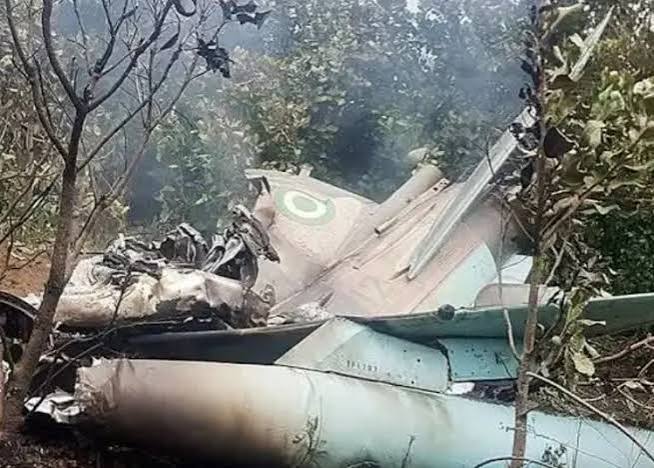
The Nigerian Air Force has constituted a board of inquiry to investigate the cause of a military aircraft crash that occurred in Igbokoda, a swampy area of Ondo State.
Also, recovery operations and preliminary investigations are underway, it was gathered.
Speaking on the investigation process, a military source confirmed that a board of inquiry, traditionally chaired by the Superintendent of Standards and Evaluation, was activated after the crash.
“A board of inquiry has been set up. Immediately after an aircraft crashes, we activated the board of specialists. The Superintendent of Standards and Evaluation is automatically the chairman of the board. It’s a permanent appointment. They have to be on the ground as they are recovering those things, because part of the recovery process forms part of the investigation,” the official stated.
Asked if the bodies had been recovered, the source said the response crew were facing hurdles at the crash site due to the dense vegetation and terrain.
The official added that a private construction firm provided specialised floating heavy equipment to clear thick vegetation in the swamp before recovery teams can access and extract the aircraft’s fuselage.
“I don’t think they’ve recovered all the bodies yet. The aircraft is deeply submerged in the swamp, and we are currently clearing the area. A construction company brought a floating buggy, or whatever it’s called. So, that’s what is clearing that path.
“Until we clear that part, we can look for what to use to lift the fuselage out of that swamp. It is going to take time before we can recover the bodies. The clearing operations remain ongoing at the site,” the source added.
Addressing public speculation regarding the age and airworthiness of the aircraft, the military official dismissed claims that the plane was outdated.
The source clarified that the aircraft was a relatively modern acquisition delivered around 2010 and properly maintained.
When contacted, the NAF spokesman, Air Commodore Ehimen Ejodame, said a comprehensive investigation into the recent military aircraft crash is already underway under the direct order of the Chief of Air Staff, dismissing concerns over the non-constitution of a formal board of inquiry.
The Air Force spokesperson explained that the service relies on standard, established aircraft investigation protocols rather than ad hoc panels, adding that official findings will be made public once the preliminary report is concluded.
“The most important thing is that the Chief of Air Staff has directed a comprehensive investigation and the outcome of that one will be communicated. Whether it’s a board, committee, or a one-man army,” he said.
Rebutting reports circulating online that 32 or more casualties were involved, the spokesman explained how the Air Traffic Control terminology led to public confusion regarding the victims.
“For air traffic controllers, when they normally communicate ‘25 souls on board inclusive of seven crew’, it is minus the seven — the seven is in the 25. It doesn’t mean you add.”
Clarifying further, he explained, “In this case, there were 25 souls on board: five were active crew, then two were passengers, but they are crew. So, there are seven crew on board reported, but only five were flying at that time. The other two were on board as passengers.”
Meanwhile, Governor Lucky Aiyedatiwa on Wednesday visited the scene of the crash, 72 hours after the tragic incident.
He issued a directive to maintain ongoing search and recovery operations for the victims and the wreckage.
The aircraft, which met with disaster, remained in the swampy terrain where it went down carrying 25 individuals on Monday and had not yet been retrieved.
Aiyedatiwa, characterizing the incident as a national catastrophe, announced that no survivors had been identified at the location at the time of his inspection, and noted that only the pilot could have provided insight into the circumstances of the crash.
The governor toured the location accompanied by members of the Nigerian Navy and Air Force, diving specialists, the National Emergency Management Agency's South-West Regional Director, the State Emergency Management Agency's Director, and community members who had engaged in rescue activities since Monday.
He characterized the scene as profoundly distressing, with human remains, personal effects, and aircraft debris recovered and secured for subsequent examination.
He stated, "The primary fuselage of the aircraft has not been located, as it remains submerged beneath the swamp."
According to his assessment, the challenging terrain conditions led him to instruct the Ministry of Works to deploy two amphibious vehicles, commonly referred to as swamp buggies, to establish improved passage through the waterways.
"These vehicles have facilitated the movement of larger rescue vessels nearer to the crash location and are being utilized to excavate the swamp in pursuit of additional wreckage components or the primary aircraft structure," he explained.
The governor further noted that the aircraft remained unlocated during his visit, while Navy personnel and indigenous diving teams persisted in their search of the deeper regions of the area.
In pursuit of locating the aircraft wreckage, the Chief of Naval Staff, Vice Admiral Idi Abbas, authorized the deployment of the Nigerian Navy Hydrographic Department's advanced sonar scanning technology to the incident site.
The sonar equipment was brought to the location to obtain a comprehensive underwater assessment of the designated area given the reduced visibility conditions of the swamp.
Rear Admiral Abubakar Mustapha, the Flag Officer Commanding of the Nigerian Navy's Western Naval Command, revealed this information during an assessment visit to the crash site on Tuesday.
Mustapha, following his engagement with the technical team and recovery personnel, urged them to accelerate their efforts in executing the recovery operation efficiently. This operation required coordinated participation from military units, emergency response agencies, security entities, technical specialists, and various other stakeholders.
The delegation under Mustapha's leadership was welcomed at the Officers' Mess of the Forward Operating Base Igbokoda by Navy Captain Andy Alemongwa, the Commanding Officer. The group subsequently proceeded to the base, where government representatives, community officials, emergency management bodies, and other stakeholders had assembled to extend their sympathies and demonstrate support for the Armed Forces.
Safety Collaboration
The incident at Igbokoda has catalyzed renewed efforts toward enhanced coordination between Nigeria's civilian and military aviation sectors. The Minister of Aviation and Aerospace Development, Festus Keyamo, and the Chief of Air Staff, Air Marshal Sunday Aneke, have committed to strengthening information exchange and safety protocols.
According to a statement issued by the minister's communications officer, Tunde Moshood, this commitment was established on Wednesday during Keyamo's condolence visit to the Chief of Air Staff following the crash.
Following his signature in the condolence register, the minister engaged in a private discussion with Aneke. Subsequently, both officials addressed media representatives regarding initiatives to reinforce collaboration between the Nigerian Civil Aviation Authority and the Nigerian Air Force.
Keyamo conveyed his condolences to the Air Force, characterizing the incident as a national catastrophe and acknowledging the dedication and sacrifice demonstrated by military personnel.
“We value the Air Force. We value the efforts of the gallant men and women of the Air Force and what they do for the country,” the minister said.
He emphasized that the incident highlighted the critical importance of eliminating the longstanding separation between civil and military aviation, observing that mishaps affect both sectors equally.
The minister noted that the Air Force currently relies on components of the nation's civil aviation infrastructure, including air traffic management systems, thereby making enhanced collaboration a logical progression.
He revealed that he had reached out to the Director-General of the NCAA and facilitated direct engagement between the organization and the Chief of Air Staff.
Keyamo stated, "This is one nation, one populace. When calamity strikes, it impacts all citizens. That air crash involved civilians, and similarly, military personnel may be present during civil aviation incidents. Consequently, it is vital that we work together on safety matters.
"We have determined that we will collaborate in the area of capacity development."
Pursuant to this agreement, Keyamo indicated that a collaborative body comprising the NCAA and NAF would be formed to facilitate cooperation in airworthiness standards, certification procedures, professional development, and additional aviation safety domains, while maintaining the distinct legal obligations of each body.
He additionally made available to Air Force personnel participation in pertinent educational initiatives administered by civil aviation regulatory bodies.
He remarked, "There exists no justification for why we should not include personnel from the Air Fo